Structural Equation Modeling in the Age of Artificial Intelligence
A Research Framework for Understanding Enterprise AI Adoption and Human-AI Collaboration

Alan F. Castillo
Publication Type:
Technical Research Framework
Author:
Alan F. Castillo
Publisher:
Cloud Computing Technologies Research Publications
Publication Date:
August 2026
Research Area:
Artificial Intelligence Adoption
Enterprise AI Strategy
Human-AI Collaboration
Structural Equation Modeling
Abstract
Artificial intelligence adoption represents a significant organizational transformation challenge requiring a deeper understanding of the relationships between technology capabilities, organizational readiness, leadership practices, and human factors.
This research framework applies structural equation modeling (SEM) concepts to examine enterprise AI adoption and human-AI collaboration. The framework extends traditional technology adoption research by incorporating emerging AI-specific factors including organizational AI readiness, trust in AI systems, human-AI collaboration maturity, governance considerations, and strategic alignment.
The objective of this framework is to provide researchers and practitioners with a quantitative foundation for evaluating how organizations successfully integrate artificial intelligence capabilities into enterprise operations.
Research Context
The rapid emergence of generative artificial intelligence is transforming how organizations approach decision-making, automation, knowledge management, and human-computer collaboration.
While previous technology adoption research examined cloud computing, enterprise systems, and digital transformation initiatives, artificial intelligence introduces new challenges involving trust, explainability, governance, security, and workforce collaboration.
This research framework extends structural equation modeling approaches into the enterprise AI adoption domain by proposing measurable constructs for evaluating organizational readiness and successful AI transformation.
From Cloud Computing Adoption to Enterprise AI Adoption
This research builds upon previous doctoral research examining organizational intentions to adopt cloud computing technologies.
The original study investigated how leadership practices and strategic intentions influenced cloud computing adoption decisions. As organizations transition from cloud-enabled environments toward AI-enabled enterprises, similar questions emerge:
• How do organizations develop AI adoption strategies?
• What organizational factors influence successful AI implementation?
• How does leadership impact human-AI collaboration?
• What factors determine sustainable AI transformation?
Relationship to Prior Research
This research builds upon established technology adoption theories and quantitative modeling approaches, including technology acceptance models, organizational readiness frameworks, and structural equation modeling methodologies.
The proposed framework extends prior research by incorporating AI-specific factors including governance maturity, AI trust, and human-AI collaboration capabilities.
Rather than evaluating AI adoption solely as a technology acceptance decision, this framework examines AI adoption as an organizational transformation process involving leadership, technology capability, governance, and human factors.
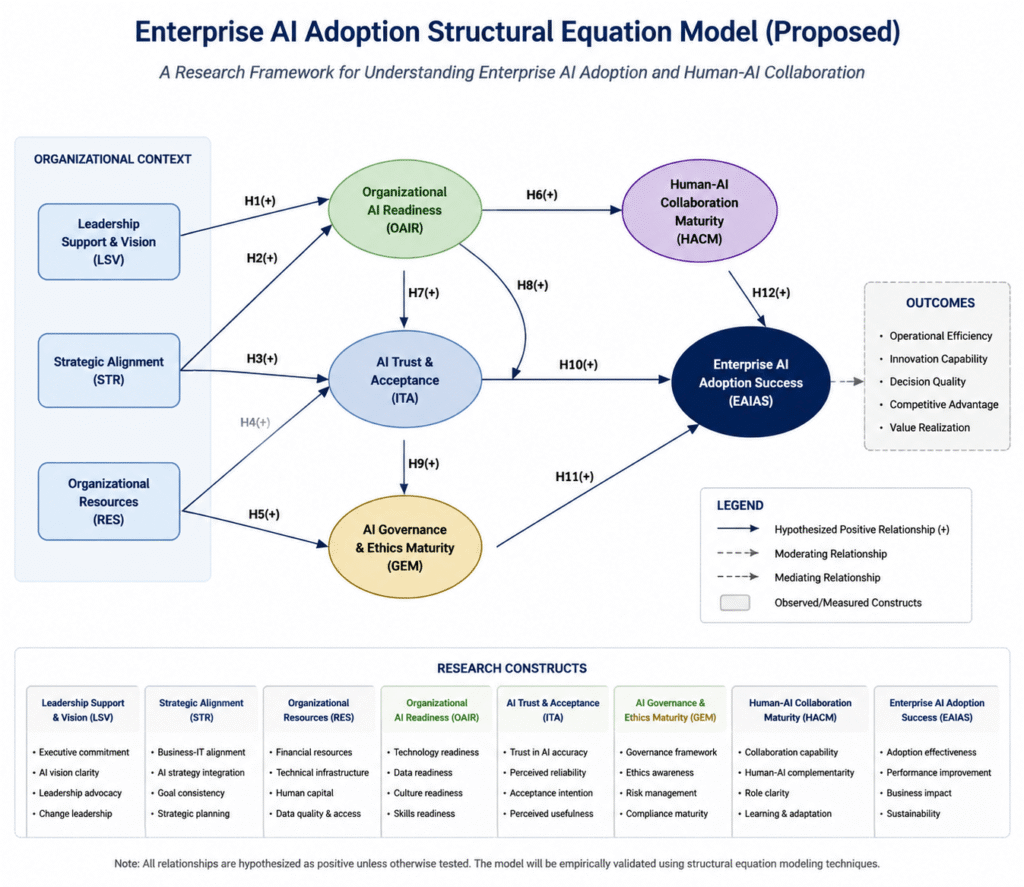
Enterprise AI Adoption Structural Equation Model
The proposed Structural Equation Modeling (SEM) framework examines the organizational, technological, and human factors that influence successful enterprise artificial intelligence adoption.
The framework extends traditional technology adoption research by incorporating emerging AI-specific constructs related to trust, governance, readiness, and human-AI collaboration.
Research Constructs and Hypotheses
The proposed Structural Equation Modeling (SEM) framework consists of interconnected constructs representing organizational, technological, governance, and human factors influencing enterprise artificial intelligence adoption.
Each construct represents a measurable dimension that can be evaluated through quantitative research methods, including survey-based measurement models and structural equation modeling analysis.
| Construct | Code | Description | Potential Measurement Indicators |
|---|---|---|---|
| Leadership Support and Vision | LSV | Represents executive commitment, strategic direction, and organizational advocacy required to successfully implement artificial intelligence initiatives. |
• Executive AI commitment • Strategic AI vision clarity • Leadership advocacy • Change management support |
| Strategic Alignment | STR | Examines how AI initiatives align with organizational objectives, business processes, and long-term transformation strategies. |
• Business-technology alignment • AI strategy integration • Organizational goals • Strategic planning maturity |
| Organizational Resources | RES | Represents availability of technical infrastructure, financial investment, workforce capabilities, and data assets required for AI adoption. |
• Technology infrastructure • Data availability • Financial resources • Human capital |
| Organizational AI Readiness | OAIR | Represents organizational preparedness to implement, integrate, and operationalize artificial intelligence capabilities. |
• Technology readiness • Data readiness • Workforce skills • Organizational culture |
| AI Trust and Acceptance | ITA | Examines confidence, perceived reliability, and willingness to incorporate AI systems into organizational workflows. |
• Trust in AI outputs • Perceived usefulness • AI reliability • Acceptance intention |
| AI Governance and Ethics Maturity | GEM | Evaluates organizational capability to manage AI responsibly through governance structures, policies, controls, and ethical practices. |
• Governance frameworks • Risk management • Responsible AI practices • Compliance maturity |
| Human-AI Collaboration Maturity | HACM | Measures the effectiveness of human and artificial intelligence collaboration in improving organizational outcomes. |
• Human-AI teamwork • Role clarity • Collaboration capability • Continuous learning |
| Enterprise AI Adoption Success | EAIAS | Represents measurable outcomes resulting from successful AI implementation and organizational transformation. |
• Operational efficiency • Innovation capability • Decision quality • Business value realization |
Proposed Research Hypotheses
The proposed Structural Equation Modeling (SEM) framework defines testable relationships among organizational, technological, governance, and human-centered AI adoption factors.
The following hypotheses represent the proposed relationships within the research model. Future empirical research will evaluate these relationships through quantitative data collection and structural equation modeling analysis.
| Hypothesis | Proposed Relationship | Research Statement |
|---|---|---|
| H1 | Leadership Support → AI Readiness | Leadership support and strategic vision positively influence organizational AI readiness. |
| H2 | Strategic Alignment → AI Adoption Success | Strategic alignment between organizational objectives and AI initiatives positively influences enterprise AI adoption success. |
| H3 | Organizational Resources → AI Readiness | Availability of organizational resources positively influences organizational preparedness for artificial intelligence adoption. |
| H4 | AI Readiness → AI Adoption Success | Organizational AI readiness positively influences successful enterprise AI adoption. |
| H5 | AI Readiness → AI Trust | Organizations with higher AI readiness demonstrate increased trust and acceptance of artificial intelligence systems. |
| H6 | AI Trust → Human-AI Collaboration | Trust in artificial intelligence systems positively influences human-AI collaboration maturity. |
| H7 | AI Governance → AI Trust | AI governance and ethical maturity positively influence organizational trust in artificial intelligence systems. |
| H8 | AI Governance → Adoption Success | AI governance maturity positively influences enterprise AI adoption success. |
| H9 | Human-AI Collaboration → Adoption Success | Human-AI collaboration maturity positively influences enterprise AI adoption outcomes. |
| H10 | AI Trust as Mediator | AI trust mediates the relationship between organizational AI readiness and enterprise AI adoption success. |
| H11 | AI Governance as Moderator | AI governance maturity moderates the relationship between AI capability and successful enterprise adoption. |
| H12 | Human Factors → Sustainable AI Transformation | Human-AI collaboration capability positively influences sustainable AI transformation outcomes. |
Research Contributions and Significance
This research framework contributes to the emerging field of enterprise artificial intelligence adoption by extending traditional technology adoption research into the era of generative artificial intelligence and human-AI collaboration.
While previous technology adoption models have examined cloud computing, enterprise systems, and digital transformation initiatives, the rapid emergence of AI-enabled technologies introduces new organizational, ethical, and human-centered considerations requiring additional research investigation.
| Research Contribution | Description |
|---|---|
| Extension of Technology Adoption Research | Extends established technology adoption frameworks by introducing AI-specific constructs related to trust, governance, organizational readiness, and human-AI collaboration. |
| Human-Centered AI Adoption | Provides a research foundation for understanding how individuals and organizations develop effective collaboration with artificial intelligence systems. |
| Enterprise AI Readiness Measurement | Introduces measurable constructs for evaluating organizational preparedness to adopt and operationalize artificial intelligence capabilities. |
| Responsible AI Governance | Incorporates governance, ethics, security, and responsible AI considerations into the evaluation of successful enterprise AI adoption. |
| Quantitative Research Foundation | Provides a foundation for empirical validation using survey instruments, measurement models, and structural equation modeling methodologies. |
| Research-to-Practice Translation | Creates a pathway for translating academic research findings into practical tools and methodologies supporting enterprise AI transformation. |
Future Research Directions
The proposed Structural Equation Modeling (SEM) framework establishes a foundation for future empirical research examining the organizational, technological, and human factors influencing enterprise artificial intelligence adoption.
Future research will focus on validating the proposed constructs through quantitative analysis, evaluating relationships among latent variables, and identifying factors that contribute to successful and sustainable AI transformation.
| Research Area | Future Investigation |
|---|---|
| Empirical Model Validation | Collect quantitative data from organizations adopting artificial intelligence technologies and evaluate the proposed SEM model using measurement and structural model analysis. |
| AI Adoption Measurement Instruments | Develop and validate survey instruments capable of measuring organizational AI readiness, trust, governance maturity, and human-AI collaboration capabilities. |
| Cross-Industry Analysis | Examine differences in AI adoption factors across industries including healthcare, government, financial services, cybersecurity, and technology organizations. |
| Human-AI Collaboration Research | Investigate how organizations develop effective collaboration models between human decision-makers and AI-enabled systems. |
| Responsible AI Governance | Evaluate the role of governance frameworks, security controls, ethical practices, and organizational policies in successful AI deployment. |
| AI Transformation Outcomes | Analyze how AI adoption influences operational efficiency, innovation capability, decision quality, and organizational performance. |
This research framework provides a foundation for advancing the understanding of enterprise artificial intelligence adoption through rigorous quantitative methods. By integrating structural equation modeling with emerging AI adoption factors, future studies can provide evidence-based insights into how organizations successfully implement trustworthy, human-centered artificial intelligence systems.
Citation Information
Castillo, Alan F. (2026).
Structural Equation Modeling in the Age of Artificial Intelligence: A Research Framework for Understanding Enterprise AI Adoption and Human-AI Collaboration.
Cloud Computing Technologies Research Publications.
Chandler, Arizona.
Structural Equation Modeling AI Adoption Framework
Citation
Castillo, Alan F. (2026).
Structural Equation Modeling in the Age of Artificial Intelligence:
A Research Framework for Understanding Enterprise AI Adoption and Human-AI Collaboration.
Cloud Computing Technologies Research Publications.
Chandler, Arizona.Structural Equation Modeling AI Adoption Framework
References
Davis, F. D. (1989). Perceived usefulness, perceived ease of use, and user acceptance of information technology.
Hair, J. F., et al. (2022). A Primer on Partial Least Squares Structural Equation Modeling (PLS-SEM).
Castillo, A. F. (2014). A Quantitative Study of the Relationship Between Leadership Practice and Strategic Intentions to Use Cloud Computing. University of Phoenix.
Publication Resources
The following resources support continued research, validation, and application of the proposed Structural Equation Modeling framework for enterprise artificial intelligence adoption.
Research Framework PDF
Full technical research publication containing the SEM framework, theoretical foundation, proposed constructs, hypotheses, and future research directions.
Coming SoonSEM Model Figure
Visual representation of the proposed Enterprise AI Adoption Structural Equation Model illustrating relationships among organizational readiness, AI trust, governance maturity, human-AI collaboration, and adoption success.
AvailableAI Adoption Measurement Instrument
Future research instrument designed to evaluate enterprise AI readiness, organizational factors, trust, governance, and human-AI collaboration capabilities.
Future ResearchAbout the Researcher
About the Author
Dr. Alan F. Castillo is a technology researcher specializing in artificial intelligence, cloud computing, enterprise transformation, and quantitative research methods. His research examines how organizations adopt and successfully integrate emerging technologies.